
A Guided Scenario was created to do three things: let learners learn how to apply what they know and demonstrate it, let them learn the patterns of what great looks like, and give the organization data on where learners are struggling and where they are doing well. This guide defines the format, walks through its anatomy, shows how it differs from the formats you already know, and lays out the evidence behind it.
A Guided Scenario is a learning experience in which the learner enters a realistic situation with 3D avatar characters, makes real decisions among plausible options, and receives expert mentoring at the moment of each choice, while the story continues along one designed spine. What makes it matter is the step it targets: application. Knowledge that is delivered but never applied recedes, and the organization's investment in delivering it fades with it. Applying the learning is the step that makes that investment pay off: it builds the learner's ability to use what they know in a real situation, and the same act of application converts the knowledge into the form that stays, as our guide on why that knowledge recedes explains. For the learner, that is the difference between knowing the content and being able to act on it. For the organization, it is the difference between a training spend that fades and one that shows up in how people perform.
The anatomy of a Guided Scenario
A Guided Scenario is built from situations and decision points. It can contain a single situation with a single decision, or several of each, depending on the scope the learning calls for, and every Guided Scenario shares the same elements. Each element does a specific job, and each connects to a fuller treatment elsewhere on this site.
The situation. A Guided Scenario opens by placing the learner inside a realistic situation rather than describing one to them. The realism that matters is situational, not visual: the real decision, the real pressures, and the learner's own working context, reproduced closely enough that the learner recognizes the moment as theirs. A plain situation built from the real stakeholder, the real objection, and the real tradeoff is more realistic, in the way that matters, than a beautifully rendered generic case. Our guide on why realism lives in the situation covers the situated-cognition evidence and the design checklist in full.
The decision points, with several plausible options. The learner acts by choosing among options at decision points. A decision point sits on a gap: the distance between what people do now and what they should do. Its options are plausible, several of them are defensible, and in many situations more than one is optimal, which mirrors how real decisions actually work. The craft of writing options that are tempting rather than obviously wrong is the subject of our guide on designing decision points.
Corrective mentoring at the choice. When a learner chooses a suboptimal or inappropriate option, they receive feedback in one of two ways: the scenario proceeds and they see how that decision plays out, like a mini branch, or mentoring steps in. Either way, they recognize why their approach is not the optimal one, and once they recognize the optimal options the story moves on. This is different from a graded test with one right answer and right/wrong feedback. The correction lands on the learner's own reasoning while it is still alive, not in a debrief paragraph after the fact. Our guide on mentoring at the decision point details how that conversation is built, and when should feedback arrive carries the memory research behind correcting at the moment of choice.
The character structure. The cast is arranged so the learner occupies the decision-making seat while a peer character carries the situation forward. Rather than putting the learner on the spot to perform, the design seats them as the advisor whose decisions steer what happens, with characters conversing naturally around them. Our guide on the hot seat versus the advisor seat explains why the seat the learner occupies changes what the scenario can do.
The single spine. The story follows one designed spine rather than fanning into a tree of divergent endings. A suboptimal choice is explored (like a mini branch point) and corrected in place, then the narrative converges before the next decision. The spine is what keeps the mentoring close to the choice and the data comparable across learners. Our guide on branching versus guided scenarios works through that structural contrast.
The decision-level data. Because every learner meets the same decision points, two signals become comparable across a cohort: what each learner chose first, before any mentoring, and how much mentoring they needed to reach a strong choice. That is a reading of applied decision-making, not a recall score. Our guide on what learning analytics should measure covers the signals and the cautions.
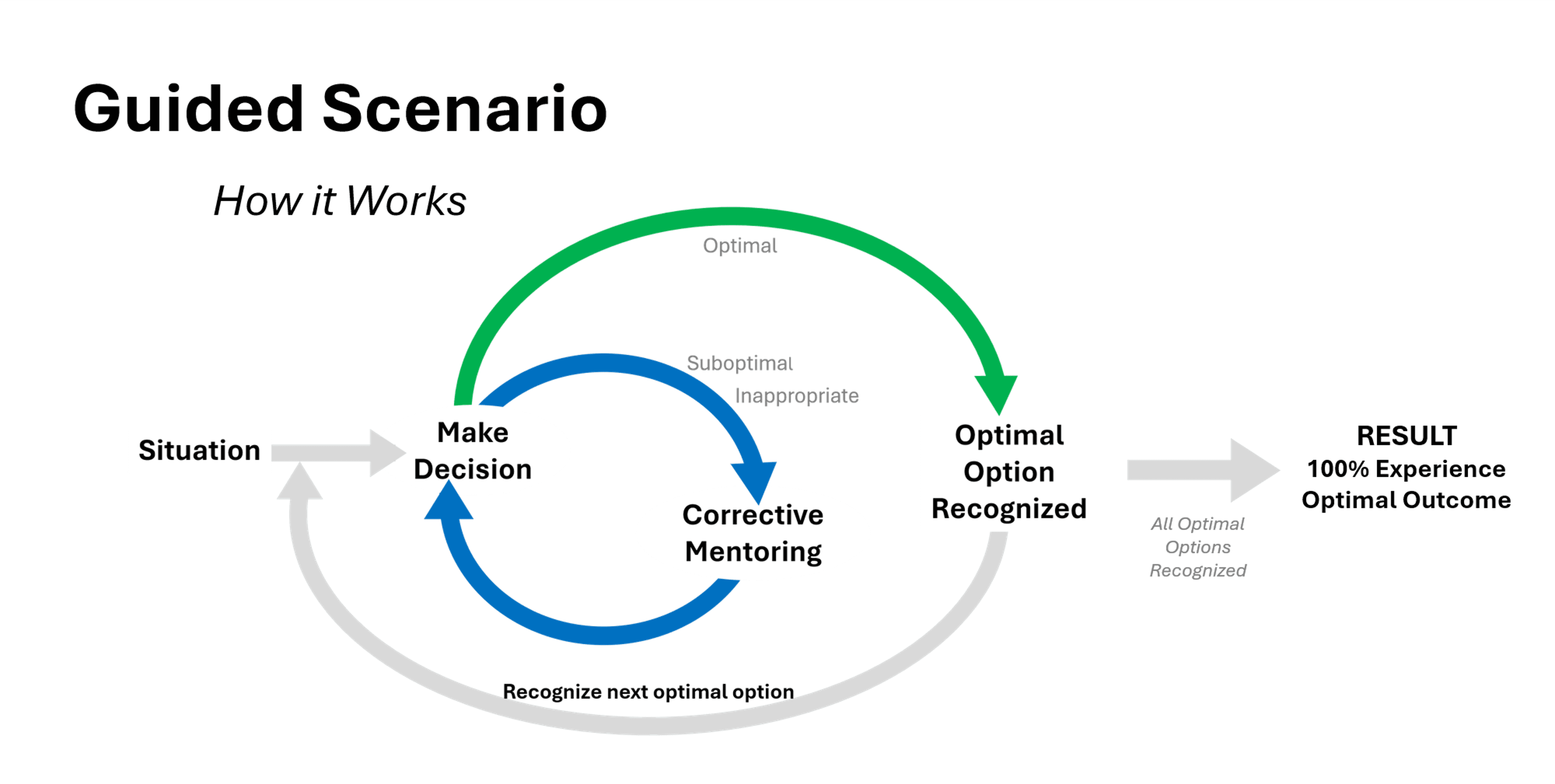
One advantage of locked-down content holds the anatomy together: the content of a scenario is authored and locked before it reaches learners, so every learner experiences the same expert-reviewed situation and the same options, while the sequence each learner takes through the mentoring is their own. Everyone experiences a unique path but arrives at the same expert-validated outcome.
How Guided Scenarios differ from the formats you know
Three comparisons place the format for readers who already work with these tools. Each is a compressed restatement of a fuller guide, not a fresh argument.
Traditional branching simulations: one spine, not a tree. A traditional branching simulation forks the narrative at every choice, so learners scatter down divergent paths and correction arrives as a single debrief at the end, detached from the decisions that produced it. With many branches, a learner meandering through cannot easily locate where their reasoning went wrong. A Guided Scenario keeps the tempting wrong options but corrects them at the moment of choice and converges back to one spine, where every learner experiences what the optimal path looks like and why, and which provides insightful analytics across all learners. The full structural contrast is in our branching guide.
AI roleplay: what to do, not how to say it. Deciding which message to deliver in a situation is about what to do, not how to say it, and that is where Guided Scenarios come in: the learner decides which strategic message the situation calls for, and the chosen message can then be rehearsed for delivery in an AI role play. Because the situations have to be authentic and nuanced to real workplace moments, the content is authored with AI acceleration and locked down before delivery, with no free-form AI conversation with the learner. The two formats sit at different stages of a program; our guide on scenario-based learning versus AI roleplay draws the line carefully.
E-learning: application, not acquisition. Traditional e-learning, built in tools like Articulate, Captivate, and iSpring, is strong at knowledge acquisition: slides, video, and quizzes that deliver content well. A Guided Scenario handles the step that comes after, where the learner learns to apply that content in a realistic situation. The two are complementary, and most programs layer a scenario on top of the e-learning that precedes it. Our guide on immersive learning versus e-learning develops the complement.
Where Guided Scenarios fit in a program, and what they measure
A Guided Scenario is the application step of a larger learning journey, not the whole of it. Knowledge acquisition comes first, and delivery rehearsal, where it is needed, comes later. Our guide on the stages of a learning program lays out that sequence and where the scenario belongs in it.
Two kinds of evidence stand behind the design, and this guide summarizes each before pointing to the guide that expands it.
The first, and the most important, is evidence of application: learners demonstrably applied what they learned, shown by improved decision-making when they met a comparable decision again later in the experience. In a matched decision-point analysis of 31,673 in-simulation decisions across seven programs, learners showed a 2.85x improvement in decision-making on matched decision points (Syandus data). A matched decision point is the same gap, with the same option set, met in a different situation later in the simulation, so a better choice the second time reflects recognition of the underlying decision rather than memory of a specific situation. This is improvement measured inside the learning experience against the learner's own first choices. While not a claim about on-the-job behavior, it is a surrogate demonstrating that learners applied knowledge successfully in carefully controlled simulations of authentic situations. Our guide on breadth versus depth explains the matched decision-point structure and why it makes learning measurable.
The second is engagement. Across programs with more than 20,000 learners, 92.3% chose to continue to subsequent scenarios without being prompted (Syandus data). That is an engagement signal, telling us learners wanted to keep going, not a learning outcome on its own. Engagement is worth defining precisely rather than asserting, and our guide on what "more engaging" actually means gives the word a testable definition.
Taken together with the mentoring criteria set out in the published continuing-education work on corrective mentoring (Seifert, 2021), the two signals describe what a well-built Guided Scenario is meant to produce: learners who applied stronger decisions inside the experience, and who wanted to stay in it.
How Guided Scenarios fit with traditional e-learning
Typically, a Guided Scenario adds the application step after traditional e-learning has delivered the knowledge: the e-learning covers the content, and the scenario is where the learner applies it. It has also been built with knowledge acquisition and decision-making integrated into a single AliveSim module, e-learning and application intermixed rather than sequenced. Full e-learning can run inside AliveSim, so the two are not an either/or choice.
For a guided look at how the format is built and deployed, AliveSim is the platform that embodies this approach.
References
- Seifert, D. (2021). Incorporating skill development in CME via corrective mentoring. Alliance for Continuing Education in the Health Professions Almanac.
Related questions
What is a Guided Scenario?
A Guided Scenario is a learning experience in which the learner enters a realistic situation with 3D avatar characters, makes real decisions among plausible options, and receives expert mentoring at the moment of each choice, while the story continues along one designed spine. It targets the application step of a program: learners learn to apply what they have already studied, in the kind of situation where knowing the content and knowing what to do with it come apart. Guided Scenarios are AliveSim's approach, refined over two decades of cognitive-science research and eight National Science Foundation awards.
How is a Guided Scenario different from a traditional branching simulation?
Both put the learner in a realistic situation and ask for decisions, so the difference is structural. A traditional branching simulation forks the story with every choice, so a wrong turn sends the learner down a divergent path and any correction waits until the end, far from the decision that caused it. A Guided Scenario keeps one designed spine: at each decision a suboptimal choice triggers corrective mentoring on the spot, the learner reconsiders, and the story converges back before the next decision. The learner still explores the wrong options and sees why they are wrong, but the correction lands at the moment of choice, and because everyone meets the same decision points the choices are comparable across learners.
How is a Guided Scenario different from AI roleplay?
They target different skills and manage content differently. AI roleplay generates fresh dialogue each session and is well suited to rehearsing how to say something, the delivery of a chosen message. A Guided Scenario is built for what to do: which message or approach a realistic situation calls for, decided before it is later rehearsed for delivery. Its content is authored with AI acceleration and locked before delivery, so every learner meets the same expert-reviewed situation and the decision data stays comparable, rather than a different conversation every time with some chance of an inaccurate response.
What kind of data do Guided Scenarios capture?
Because every learner meets the same decision points, a Guided Scenario captures each learner's first choice before any mentoring, which shows where learners start and which options tempt them; which situations needed the most mentoring; improvement at matched decision points met again later; and cohort-level patterns across all of it. Our guide on what learning analytics should measure covers the signals and the cautions.
Published July 18, 2026 · 9 min read