
We usually start a design from how an expert sees the world. The expert tells us what should be done and how knowledge should be applied, all of it grounded in a mental model built over years of experience, and it makes complete sense to start there, because most knowledge delivery is structured exactly that way. This guide challenges that. The learner's mental model is nothing like the expert's. It has gaps and misconceptions and is nowhere near the expert's understanding, so pushing the expert's thinking onto the learner and expecting them to adapt is a tall order, and that is why behavior change fails.
This is why so many of our guides center on the gaps: learner-centered design that focuses on the learner's model rather than on pushing expert knowledge. The gaps our other guides find describe today's behavior; this guide is about the mental model underneath that produces it. That paradigm underpins nearly every guide on the site, from finding the gaps to cognitive apprenticeship.
Mental models, in plain terms
A mental model is the internal structure a person uses to make sense of the world. It is how we organize information, recognize patterns, and decide what to do, built up over time from memory, concepts, and beliefs about cause and effect. The popular summary at Farnam Street puts it simply: a model is a compressed explanation of how something works, a map that keeps the important features and drops the rest. The academic root is the cognitive scientist Philip Johnson-Laird's 1983 account of mental models. Two properties of these models drive everything that follows. They are dynamic, so they change with experience, and they are largely hidden, so neither the learner nor the expert can easily access one directly. New information always lands on top of what the learner already believes.
Applying knowledge can fail in two ways
When a learner tries to apply new knowledge, they run it against the model they already hold, and there are two ways that comparison goes wrong.
The first is a misconception. The new knowledge contradicts something the learner already believes. The contradiction produces cognitive dissonance, and dissonance resolves far more easily by rejecting the new knowledge than by rebuilding the model, so the result is resistance, disbelief, or misunderstanding.
The second is a gap. The new knowledge does not contradict the model, but it sits so far from it that there is no path to attach it, so nothing is assimilated. These are the same gaps and misconceptions our other guides discuss, grounded in the learning science of how models accept or reject new material.
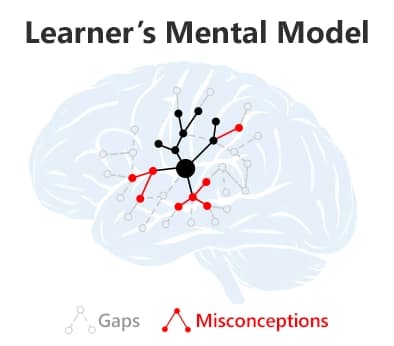
The two failures need different design responses, and both are invisible to a knowledge test, which is the crucial point. A learner can produce the right answer on the page while the model that drives their behavior stays exactly where it was. This is where the site's guides nest into each other. Those gaps describe today's behavior, which our finding-the-gaps guide sorts into information gaps, misconceptions, and what it calls discontinuities. This guide is the layer below even that: the mental model that produced the behavior in the first place. How to design around these misconceptions and gaps is developed further in the Mental Model Learning Framework later in this guide.
The paradigm shift: whose model are we building?
The expert's real value is not the list of facts they can recite. It is their judgment about applying knowledge in real situations, and that judgment is where their years of experience live. Conventional design expects the learner to absorb that judgment without ever being shown how the expert thinks. It states what should be known and done, then tests whether the learner can repeat it. Every graduate who aced the quiz and changed nothing is the recognizable symptom. Making expert thinking visible is the heart of cognitive apprenticeship, and it is exactly what conventional delivery leaves out.
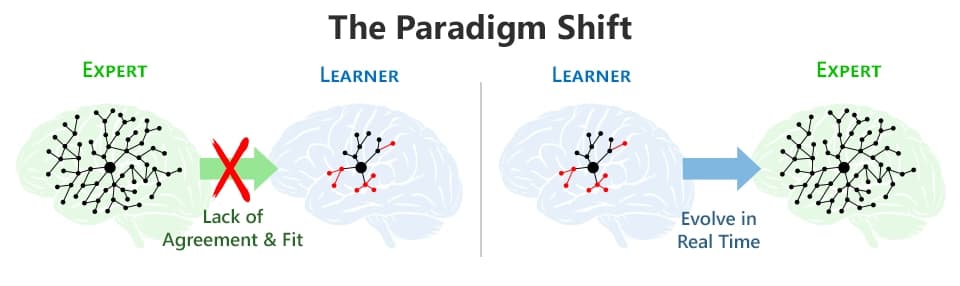
The shift is simple to state. Do not tell the learner what an expert would do. Start from the learner's own model, let them make real decisions, and let them learn how the expert thinks through feedback at those decisions, closing gaps and dissolving misconceptions as their own model evolves. Put the learner in an authentic situation where a decision matters and let them act on the model they already hold; when that model has a gap or a misconception, the decision reveals it. That is the moment for feedback drawn from how the expert thinks, not a correct answer handed over to be memorized.
This feels intuitive, and it is supported by research. In implementation science, the study of why evidence-based practices do or do not get adopted, Holtrop and colleagues argue that resistance to a well-supported practice is frequently a conflict of mental models rather than a shortage of information (Holtrop et al., 2021). Their worked case is shared decision-making in medicine: physicians resist a decision aid not because they lack data but because the aid does not fit their model of their own role, so more information does not move them.
Finding the expert's model, and finding the learner's
Both models are largely hidden, and neither is easy to put into words. Work on eliciting expert models shows how much is lost when you try to get one onto paper: even careful, direct elicitation captures a fraction of what an expert actually knows (LaMere et al., 2020).
For the expert, the move is to extract their thinking processes, not just their conclusions. That is part of the cognitive apprenticeship model, and our guide to extracting expert knowledge is the method for recovering more of it.
For the learner, you locate their model through the gap between what they are doing now and what they should be doing. Today's behavior is the output of their current model, which is why finding the gaps is where a design first starts to see the learner's model at all.
Then the move that uses both: put learners in situations, provide expert guidance and mentoring drawn from the expert's extracted thinking, and their model evolves toward making decisions the way an expert would.
What the design looks like
Three moves follow from starting with the learner's model.
The first is diagnostic. A decision in an authentic situation is the instrument, because the learner's first instinct at a decision point shows where their model is compared to where the expert's would lead. No survey or pretest surfaces this as cleanly, because the learner is acting rather than reporting.
The second is timing. Feedback belongs at the moment of the choice, while the learner is still immersed in the reasoning that produced it. That is when they are most receptive, because the flawed step is still in view and can be corrected against it. Waiting until the end of a case or a module loses the context that made the correction legible.
The third is measurement, through decisions rather than recall. What you track is how decision-making evolves across situations: where the learner needed guidance, and when they began choosing the better option on their own.
This is also where varied situations do their work. A model does not become robust by being corrected once; it becomes robust by meeting the same underlying decision across situations that differ on the surface. The cognitive scientist Rand Spiro describes the capability this builds: "Cognitive Flexibility is about preparing people to select, adapt, and combine knowledge and experience in new ways to deal with situations that are different than the ones they have encountered before" (Spiro et al., 2003). A model that has evolved shows itself precisely there, in situations the learner has not seen before.
The Mental Model Learning Framework
The approach comes down to four moves: begin from the learner's model, surface its gaps and misconceptions through real decisions, correct at the moment of choice with what was extracted from the expert's thinking, and measure how the learner's own mental model evolves. AliveSim's framework, the Mental Model Learning Framework, is the systematized form of exactly this approach, honed through research supported by the National Science Foundation and deliberately its own framework rather than a restatement of the academic literature.
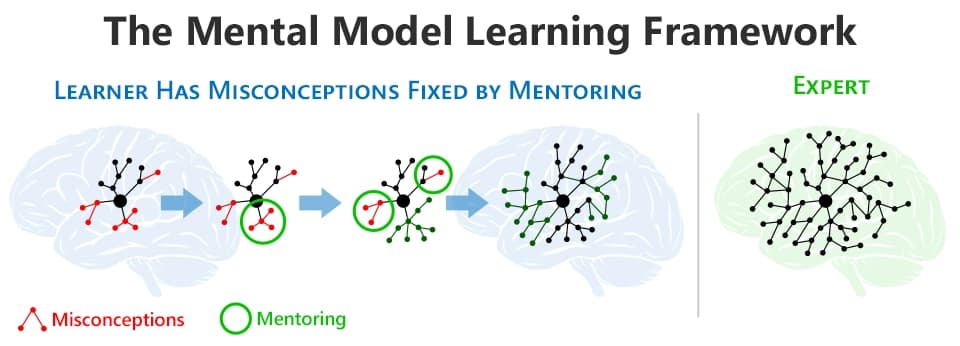
The platform is where the approach becomes deliverable at scale. In AliveSim's Guided Scenarios, the learner enters a realistic situation, makes real decisions, and receives corrective mentoring at the moment of each choice, and the record of those decisions is what shows a model changing. In the published medical programs the effect is visible in exactly the form the framework predicts: physicians improve their decision-making within a module, and in later, different situations they increasingly chose the better clinical option on their own, as their model of when and why it applies takes hold. The full argument, with the sales and clinical cases, is published on the Syandus blog (Seifert).
The point of it all
The learner's mental model is the starting point. The work is evolving their thinking so they can think more like an expert and perform better in the real situations they face. So much of learning teaches what experts know; the real challenge is helping learners apply what experts know in real situations. Change the design paradigm and you greatly improve a learner's ability to apply knowledge, build a more robust mental model, and gain the confidence to change their behavior.
References
- Holtrop, J. S., Scherer, L. D., Matlock, D. D., Glasgow, R. E., & Green, L. A. (2021). The Importance of Mental Models in Implementation Science. Frontiers in Public Health, 9, 680316.
- Johnson-Laird, P. N. (1983). Mental Models: Towards a Cognitive Science of Language, Inference, and Consciousness. Harvard University Press.
- LaMere, K., Mäntyniemi, S., Vanhatalo, J., & Haapasaari, P. (2020). Making the most of mental models: Advancing the methodology for mental model elicitation and documentation with expert stakeholders. Environmental Modelling & Software, 124, 104589.
- Seifert, D. (2023). Mental Models: The Secret to Effective Education and Training Outcomes. Syandus Blog.
- Spiro, R. J., et al. (2003). Cognitive Flexibility Theory: Hypermedia for Complex Learning, Adaptive Knowledge Application, and Experience Acceleration. Educational Technology, 43(5), 5–10.
Related questions
What is a mental model in learning?
A mental model is a person's internal representation of how some part of the world works. It is built from memories, concepts, and cause-and-effect beliefs, and it is what lets someone organize information, recognize a situation, and decide what to do. Two features matter for learning design. Mental models are dynamic, meaning they change with experience, and they are largely hidden, meaning neither the learner nor the expert can easily access one directly. The academic root of the term is the cognitive scientist Philip Johnson-Laird's 1983 work, and the idea now runs through fields as far apart as implementation science and instructional design. For a designer, the practical point is that new information always lands on top of what the learner already believes, and that existing model will either accept it, fight it, or fail to connect to it.
Why do learners pass the test but not change their behavior?
Because passing a knowledge test shows the information was received, not that the learner can apply it. Applying new knowledge can fail in two ways. It can contradict a belief the learner already holds, which produces dissonance and then resistance, disbelief, or misunderstanding. That is a misconception. Or it can sit so far from the learner's model that there is no path to attach it, so nothing is assimilated. That is a gap. A learner can memorize what an expert says to do, but that does not mean they have internalized it, believe it is the best way, or understand why it is, so the underlying model stays exactly where it was and the behavior does not change. This is the failure a well-taught, well-received, quiz-passing program most often hides.
What does it mean to start from the learner's mental model?
It means designing the experience around the learner's current model instead of the expert's finished one. The conventional approach lays out what an expert knows and does, then tests whether the learner can repeat it. Starting from the learner's model reverses the order: put the learner in an authentic situation and ask them to decide. Their first instinct at that decision reveals where their model actually is, including the gaps and misconceptions that a lecture would never expose. That is the moment for feedback, because the learner is still inside their own reasoning and can see why it fell short. The aim is not to replace their thinking with the expert's but to help their own model evolve toward it, so they can act on it in the situations they will actually face.
How do you measure whether a mental model changed?
Through decisions, not recall. A recall test tells you whether a learner can state the expert's answer, which the earlier questions show is not the same as a changed model. Watching decisions across a sequence of situations tells you something a test cannot: where the learner needed guidance, which situations still tripped them up, and whether they began choosing the better option on their own as the situations varied. A model that has genuinely evolved shows up as improving decisions in situations the learner has not seen before, rather than a higher score on a familiar quiz. This is also why the data is worth capturing at the decision level: patterns across many decisions reveal which parts of the model are still forming and where future programs should aim.
Published July 18, 2026 · 10 min read