
Kolb's experiential learning cycle may be the most cited and least implemented model in learning and development. It appears in design documents and needs analyses across the industry, and then the resulting program ships as a content sequence with a quiz. The citation is sincere. The failure is structural: slides can carry concepts and quizzes can carry assessment, but experience and experimentation do not fit in a bullet point, so they get silently dropped, and what remains is one stage of a four-stage model, still presented under the model's name.
This guide covers what Kolb actually proposed, what each stage demands from a learning design, why most implementations fail at predictable points, what a faithful implementation requires, and how mentored scenario formats map onto the cycle, including where the mapping compresses stages and why that compression is defensible.
What did Kolb actually propose?
David Kolb published Experiential Learning: Experience as the Source of Learning and Development in 1984, synthesizing a tradition that runs through John Dewey's work on experience and education (Dewey, 1938), Kurt Lewin's action research, and Jean Piaget's account of cognitive development. The book's central definition is compact: "Learning is the process whereby knowledge is created through the transformation of experience" (Kolb, 1984, p. 38). Both halves of the sentence carry weight. Experience is the source material, and transformation is the mechanism. Untransformed experience is just events; content without experience is just information.
The cycle operationalizes that definition in four stages:
- Concrete experience. The learner is fully involved in a specific, real situation.
- Reflective observation. The learner steps back and examines the experience from multiple perspectives.
- Abstract conceptualization. The learner forms concepts and generalizations that integrate the observations into a usable theory.
- Active experimentation. The learner uses those concepts to make decisions and act in new situations, testing their implications.
The action taken in stage four generates a new concrete experience, and the cycle continues. Two structural points from the source are worth preserving because popular summaries drop them. First, the stages sit on two dimensions of tension: concrete experience and abstract conceptualization are opposing ways of grasping experience (direct involvement versus theoretical comprehension), while reflective observation and active experimentation are opposing ways of transforming it (internal examination versus external action). Learning, for Kolb, requires resolving both tensions, which is why no single stage can substitute for the others. Second, the cycle is better drawn as a spiral. Kolb and Kolb (2005) describe learning as recursive, each pass deepening the last, captured in their proposition that all learning is relearning. A learner can enter the cycle at any stage; what the model does not permit is stopping after one.
What does each stage demand from a learning design?
Treating the stages as a design specification, rather than a diagram, makes their demands concrete.
Concrete experience demands a situation, not a description of one. Kolb's first stage requires the learner's full, open involvement in something specific. A case study read in the third person is not an experience; it is conceptual input about someone else's experience. The stage is served when the situation is particular rather than generic, when it unfolds rather than being summarized, and when the learner's own choices have consequences inside it. Emotional texture is not decoration here: a defensive employee or a skeptical customer engages the learner as a participant, and participation is what the stage is for.
Reflective observation demands structured attention to what actually happened. The second stage asks the learner to examine the experience from multiple perspectives before judging it. This is close to what Schön calls reflection-on-action (Schön, 1983, 1987): the deliberate, after-the-fact examination of an episode of professional work. The demand on the designer is specificity. Reflection prompts must point at the particulars of the experience the learner just had ("what changed when the customer heard the price?") rather than at the topic in general ("what are some challenges in pricing conversations?"). Reflection on nothing in particular produces opinions, not observations.
Abstract conceptualization demands expert framing. The third stage is where instruction legitimately enters the cycle. Observations become useful when they are integrated into concepts: names for what happened, models that explain it, principles that predict when it will happen again. Learners rarely generate strong concepts unaided, which is why the cycle benefits from an expert voice at exactly this point. The critical design property is placement. When concepts arrive after an experience, the learner has something to attach them to; the same concepts delivered first, as most courses deliver them, arrive with nothing for the learner to attach them to.
Active experimentation demands a second attempt with something at stake. The fourth stage is where the learner acts on the revised understanding: chooses an approach, carries it into a situation, and finds out what it does. This is the stage that converts a concept the learner received into a concept the learner has tested, and its output is the next concrete experience, which is what makes the cycle a cycle. It is also, as the next section argues, the stage the industry most consistently fails to provide.
Why do most programs cite Kolb and fail to implement him?
The failures are predictable because they follow the economics of course production. Content is cheap to author and easy to scale; experience and experimentation are not. So programs converge on the same three substitutions.
Courses deliver conceptualization only. A typical e-learning module is abstract conceptualization from the first screen to the last: definitions, frameworks, worked principles, a knowledge check. That is one stage of four, with nothing for the concepts to explain and no opportunity to test them. The broader evidence on passive formats is consistent with the model's prediction. Freeman and colleagues' 2014 meta-analysis of 225 studies found that students in traditional undergraduate STEM lecture courses were 1.5 times more likely to fail than students in active learning formats, and that active formats raised examination performance by 0.47 standard deviations. Learners who must use knowledge outperform learners who receive it.
Discussion questions fake reflection. Adding "reflection questions" to a content module looks like stage two but is not. Reflective observation requires an experience to observe. When there has been no concrete experience, the prompt "reflect on a time when you faced a difficult conversation" outsources the experience stage to the learner's memory, unshared, unobserved, and unavailable for expert framing. Reflection worksheets complete the illusion: the learner produces text, the program records engagement, and no observation of any specific event has occurred.
The experimentation loop never happens. This is the quietest failure and the most consequential. Even programs that engineer a genuine experience and a real debrief usually end there, at three stages out of four. The learner leaves with a concept they have discussed but never acted on. Kolb's model is consistent with what the transfer literature observes in this case: understanding that does not survive contact with the job, because the link between the concept and action was never built. The fourth stage is not an enrichment activity. It is where learning either consolidates or evaporates.
What does a faithful implementation require?
Stripped to essentials, a design implements Kolb when it provides four things in a closed loop.
- A realistic situation to experience. Specific, unfolding, consequential, with the learner inside it making moves rather than outside it reading about it.
- Structured reflection on what happened. Prompts and conversation anchored to the particular events of the learner's own run through the situation, not to the topic in general.
- Expert framing that turns reflection into concepts. A mentor, instructor, or modeled expert voice that arrives after the experience and gives the learner language, models, and principles for what they just went through.
- A chance to try again. A return to the situation, or a comparable new one, where the learner acts on the revised understanding and sees what it produces. This is the step most programs never provide, and no accumulation of the first three substitutes for it.
Sequencing deserves a note. Kolb allows entry at any stage, and many strong designs do begin with brief conceptual grounding before the first experience. Content-first ordering is not the violation. The violation is content-only: delivering stage three, at scale, forever, and calling the result experiential.
How do guided scenarios map to the cycle, and where does the mapping strain?
The format that most directly implements the full loop is the mentored scenario: a realistic situation rendered as an unfolding interaction, in which the learner makes decisions, receives expert guidance tied to each decision, and continues through the consequences. The mapping to Kolb is straightforward. The live situation, with its specifics and stakes, is the concrete experience. The step-out moment in which a mentor examines what just happened supplies reflective observation. The mentor's framing, and the learner's decision about which approach is right, supply abstract conceptualization. The return to the situation, where the chosen approach plays out, is active experimentation, and its outcome is a new concrete experience. A single scenario can run this spiral several times, each pass sharpening the learner's pattern recognition.
One point of honesty keeps this mapping credible. In a mentored conversation, reflection and conceptualization usually compress into a single moment. The mentor asks what happened and offers framing in the same exchange, and the learner's decision fuses observation with concept. A purist implementation would stage the two separately, with unframed reflection preceding any conceptual input, and nothing in Kolb's own account authorizes collapsing them. The compression is a design adaptation, and it should be claimed as one. It is a defensible adaptation on two grounds: the function of both stages is preserved, because the learner examines the particulars of the experience before generalizations are applied to it, and the realistic alternative in most programs is not a purer sequence but no reflection and no grounded conceptualization at all. Designers should hold their own formats to the same standard rather than asserting stage-perfect fidelity that no practical design achieves.
This loop is the design basis of AliveSim's Guided Scenarios, where learners learn to apply what they have studied inside realistic conversational situations with expert mentoring at each decision point, and the within-experience evidence is consistent with the model's prediction (Syandus data).
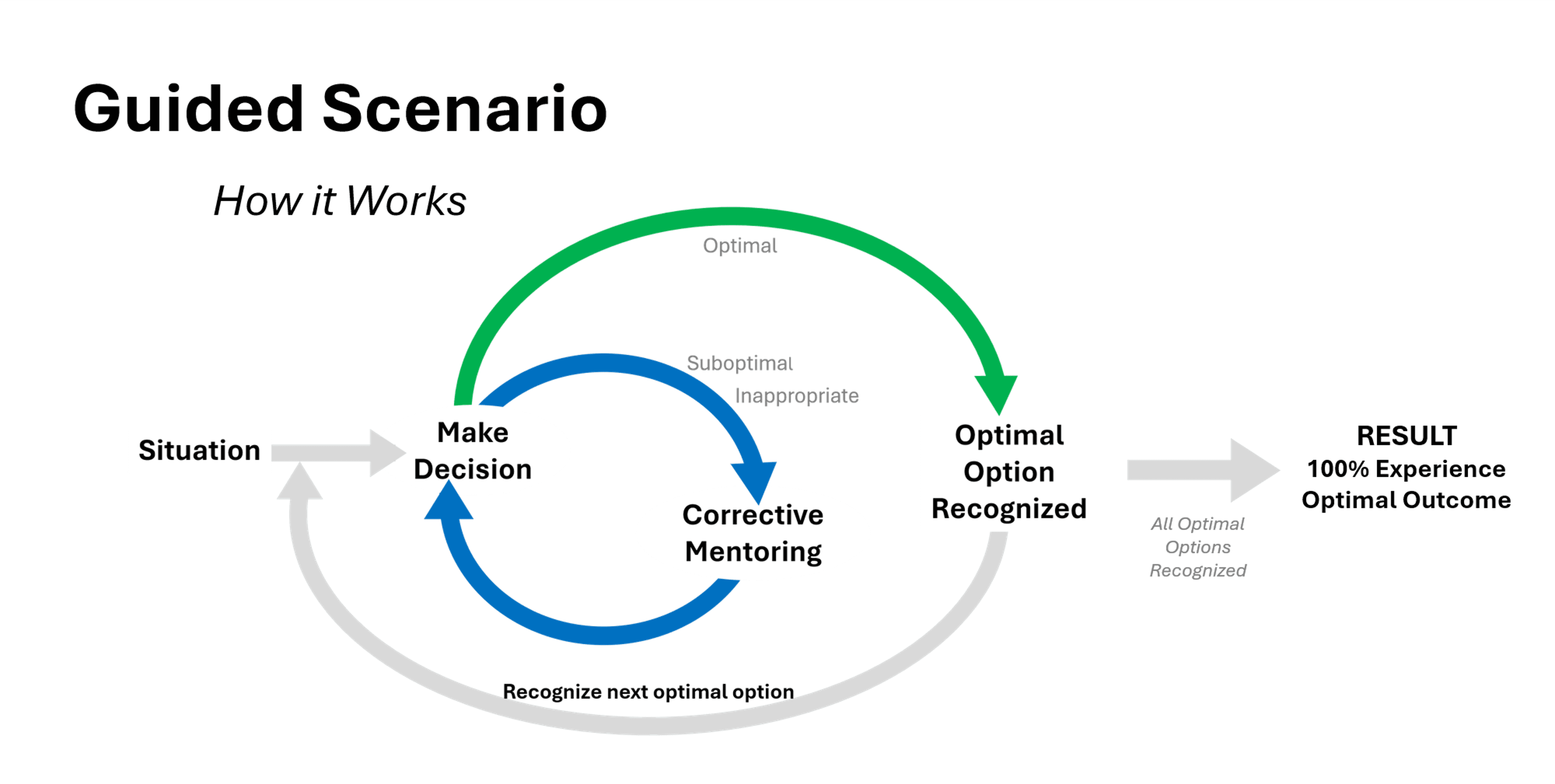
The principle, though, is independent of any platform: any format that closes the full loop is implementing Kolb, and any format that does not is citing him.
What should instructional designers check before claiming Kolb?
A short audit, applied to the actual learner experience rather than the design document.
- Point to the experience. Identify the moment the learner is inside a specific situation rather than being informed about one. If no such moment exists, there is no experience to learn from.
- Check what the reflection is about. After a decision, the learner should get an evaluation of the specific choice they made and why it worked or fell short, not a bare right-or-wrong mark, and not silence. Feedback that ignores the learner's own run indicates faked stage two.
- Check when concepts arrive. At least once in the program, expert framing should be part of or follow an experience rather than precede everything. If all concepts are front-loaded, the learner never conceptualizes from experience.
- Find the second attempt. Locate where the learner acts on their revised understanding and sees consequences. If the program ends at the debrief, the cycle is three-quarters complete, which Kolb's model treats as incomplete.
- Look for the spiral. One loop is a demonstration; repeated loops through varied situations are what build durable judgment. Check whether the design revisits comparable decisions more than once.
- Measure across passes. First choices before guidance, compared with choices in later passes, are the natural evidence that the cycle is doing what the model claims. A program that runs the loop can show the change; a program that cannot show it should ask whether the loop is really running.
Kolb drew the map more than four decades ago, and whatever the fate of the contested learning-styles apparatus built alongside it, the cycle has held up. What the field owes it now is not more citation but implementation: experience, reflection, concept, and the attempt most programs never provide.
References
- Dewey, J. (1938). Experience and Education. Kappa Delta Pi; Macmillan.
- Freeman, S., Eddy, S. L., McDonough, M., Smith, M. K., Okoroafor, N., Jordt, H., & Wenderoth, M. P. (2014). Active learning increases student performance in science, engineering, and mathematics. Proceedings of the National Academy of Sciences, 111(23), 8410–8415.
- Kolb, A. Y., & Kolb, D. A. (2005). Learning styles and learning spaces: Enhancing experiential learning in higher education. Academy of Management Learning & Education, 4(2), 193–212.
- Kolb, D. A. (1984). Experiential Learning: Experience as the Source of Learning and Development. Prentice-Hall.
- Schön, D. A. (1983). The Reflective Practitioner: How Professionals Think in Action. Basic Books.
- Schön, D. A. (1987). Educating the Reflective Practitioner. Jossey-Bass.
Related questions
What are the four stages of Kolb's experiential learning cycle?
Kolb defines four stages: concrete experience (full involvement in a specific, real situation), reflective observation (examining that experience from multiple perspectives before judging it), abstract conceptualization (forming general concepts and theories that integrate the observations), and active experimentation (using those concepts to make decisions and act in new situations). The stages sit on two dimensions: concrete experience and abstract conceptualization are opposing ways of grasping experience, while reflective observation and active experimentation are opposing ways of transforming it. Learning, in Kolb's account, requires resolving both tensions, which is why touching all four stages matters more than starting at any particular one.
What is experiential learning?
Experiential learning is the theory that knowledge is created through the transformation of experience rather than through the transmission of content. Kolb's 1984 formulation, which draws on Dewey, Lewin, and Piaget, is the most widely used version in workplace learning and higher education. It does not mean simply 'learning by doing.' Unstructured doing produces unreliable learning; Kolb's model requires that experience be transformed, through reflection and conceptualization, into concepts the learner then tests deliberately. An experience that is never reflected on, and a concept that is never acted on, are both incomplete learning by this definition.
Why do experiential learning programs fail?
Most fail because they implement one stage of a four-stage model. Courses, videos, and slide decks deliver abstract conceptualization: general concepts with no concrete experience beneath them. Discussion prompts and reflection worksheets often fake reflective observation, because they ask learners to reflect in general rather than on the specific events of a shared experience. And almost no program provides active experimentation, the chance to act again on a revised understanding. A program can also fail at the front end by treating a described scenario as an experience; reading about a situation is conceptual input, not experience. The cycle only produces its results when it closes.
Do you have to go through Kolb's stages in order?
Kolb presents the cycle as recursive: a learner can enter at any stage, and real learning spirals through the stages repeatedly rather than completing one clean loop. The sequence still carries the logic of the model, because each stage feeds the next: experience gives reflection something real to examine, reflection gives conceptualization its raw material, concepts give experimentation a hypothesis to test, and experimentation generates the next experience. In applied designs the stages also blur; reflection and conceptualization frequently happen within a single mentored conversation. That compression is a reasonable design adaptation as long as both functions are genuinely served and the loop eventually closes with another attempt.
Published June 17, 2025 · Updated July 14, 2026 · 11 min read